
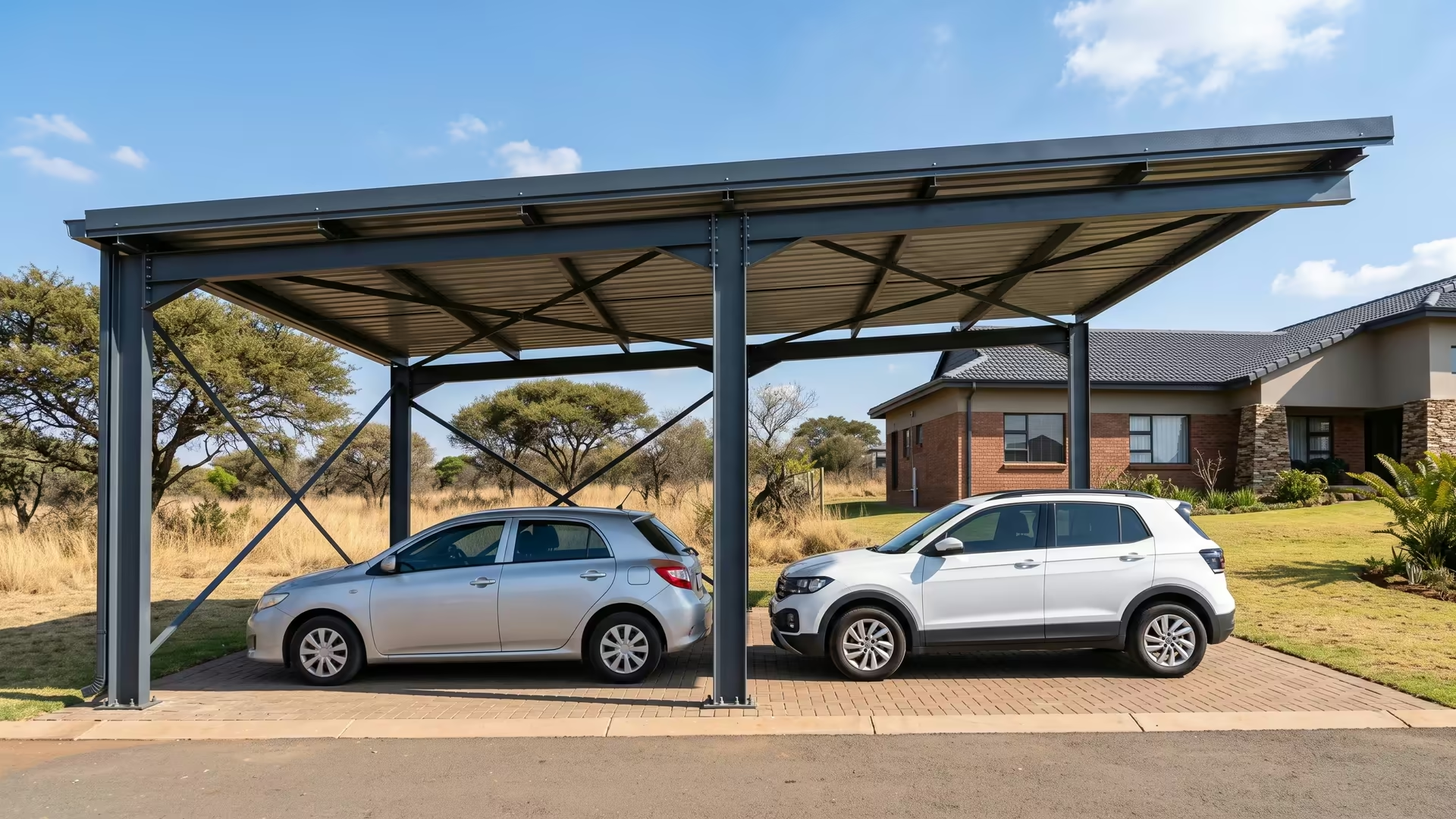
Standard carport dimensions
Five footprints cover almost every South African carport: 3m × 6m single, 6m × 6m double, 3m × 12m tandem double, 9m × 6m triple and 12m × 6m four-bay. All five are 6 m deep, because that is what a car needs to sit fully under cover with the boot open. Width is what changes, and it changes in 3 m steps — one bay per vehicle.
| Carport | Width × depth | Vehicles |
|---|---|---|
| Single | 3m × 6m | 1 car / bakkie |
| Double (side-by-side) | 6m × 6m | 2 cars |
| Double (tandem) | 3m × 12m | 2 cars in line |
| Triple | 9m × 6m | 3 cars / boat bay |
| Four-bay | 12m × 6m | 4 vehicles |
Size your carport
Width, depth and height rules of thumb
Allow 3 m of width per car for comfortable door-opening, 2.5 m at an absolute minimum. Keep 6 m of depth so a car sits fully under cover with the boot up; a bakkie or a long SUV wants 6.5 m. For height, measure your tallest vehicle and add 300 mm — a standard 2.1 m beam clears a sedan, while a 4x4, a bakkie with a canopy or a roof box needs 2.4–2.7 m. These dimensions feed straight into carport prices in Johannesburg, and the roof style that fits the size is under carport designs. Each standard footprint has its own page — the single carport at 3m × 6m, the double carport at 6m × 6m and the triple carport at 9m × 6m. Once the size is settled, the material and price bands are on the main range of carports in Johannesburg.
Sizing for South African vehicles
These are South African carport sizes, set against the vehicles actually parked on a Johannesburg stand. A double-cab bakkie is the size that catches people out: at roughly 5.3 m long and 1.85 m tall before a canopy, it needs the full 6 m of depth and a beam well above the 2.1 m that clears a hatchback. Measure the vehicle, do not assume the class.
| Vehicle | Typical length | Height with load | Minimum beam |
|---|---|---|---|
| Hatchback / sedan | 4.2 – 4.8 m | 1.45 – 1.5 m | 2.1 m |
| SUV / crossover | 4.6 – 4.9 m | 1.7 – 1.8 m | 2.1 – 2.4 m |
| Double-cab bakkie | 5.3 – 5.6 m | 1.85 m, 2.1 m with canopy | 2.4 m |
| Bakkie with roof rack / 4x4 | 5.3 – 5.6 m | 2.2 – 2.4 m | 2.7 m |
| Caravan / boat on trailer | 6 – 7 m | 2.4 – 2.6 m | 2.7 m + 7 m depth |
Two Johannesburg constraints sit on top of the vehicle measurement. Freehold stands in areas such as Randburg usually have room to set the posts where they suit the driveway. Estates and complexes in Midrand and Fourways often fix the beam height and roof pitch in a written design manual, so the size is decided by the HOA before it is decided by the car. Where a post would land in the door-opening line, a cantilever carport removes the front posts entirely and the usable width becomes the full span.
Common questions
What is the standard size of a double carport?
A standard double carport is 6m × 6m for two cars side by side. Where the driveway is narrow, a tandem double of 3m × 12m covers two cars in line. Both are 6 m deep to clear a parked car with the boot open.
What height should a carport be for a bakkie or 4x4?
A carport for a bakkie with a canopy or a 4x4 needs a beam height of 2.4–2.7 m, against 2.1 m for a sedan. Measure your tallest vehicle and add 300 mm of clearance.
How much width does each car need under a carport?
Allow 3 m of width per car for comfortable door-opening, or 2.5 m at an absolute minimum. So a double carport is 6 m wide and a triple 9 m wide.
What size carport fits a double-cab bakkie in South Africa?
A double-cab bakkie is 5.3–5.6 m long and 1.85 m tall, or about 2.1 m with a canopy, so it needs a single bay of 3m × 6m with a beam of at least 2.4 m. Add a roof rack and the beam goes to 2.7 m.